Psilocybin and depression: what the research shows
The effect is real and it is smaller than you have been told. Every result on this page is reported with the thing that qualifies it — sample size, comparator, and whether the primary endpoint was met.
The short answer
Psilocybin’s effect on depression is real, statistically significant and modest. Two Phase 3 trials of synthetic psilocybin met their primary endpoints, with differences of 3.6 and 3.8 MADRS points against control — genuine results, and in the same broad range as conventional antidepressants in acute trials rather than something categorically different. The single most-quoted trial in the field, psilocybin against escitalopram in 2021, did not meet its primary endpoint at all. Almost every trial required participants to stop their antidepressants first, so the published numbers describe unmedicated people.
- Phase 3 trials meeting endpoint
- 2 of 2
- Difference against control
- 3.6 and 3.8 MADRS points
- Escitalopram trial primary outcome
- Not met
- US adults with TRD
- ~2.8 million
The results
What the trials actually found
Three randomized trials and one real-world program carry almost all of the weight here. They do not all point the same way.
The strongest depression results come from the Compass Phase 3 program. COMP005 and COMP006 both met their primary endpoints: a difference of 3.6 MADRS points against placebo at week six, and 3.8 points for a 25 mg dose against a 1 mg active comparator.[1] Two things follow from that, and both are true at once. Meeting a primary endpoint in two Phase 3 trials is a serious result that most investigational psychiatric drugs never reach. And a few points on a sixty-point scale is a modest change, released so far as sponsor topline data rather than published in full.
The 2023 JAMA trial of a single 25 mg dose randomized 104 people with major depressive disorder against niacin and reported a significant reduction in depression scores over six weeks.[3] It is the cleanest positive trial in non-resistant depression. It is also where the medication problem below starts, because participants had to come off antidepressants to enter it.
Set against those, the 2021 escitalopram trial did not meet its primary endpoint, and the Oregon program data is observational. Neither is a reason to dismiss the literature. Both are reasons to size it correctly, which is what the rest of this page does.
What this page does not do is pool those trials into a single number. A living meta-analytic database of randomized psilocybin trials in depression is maintained by the Metapsy project, run by researchers at the Vrije Universiteit Amsterdam and two German universities on data compiled by the Sypres collaboration.[10] A pooled estimate from a database like that is a better instrument than any single trial for the question of what this literature averages to. The figures are computed when a reader runs an analysis rather than stated on the page, and the page carries no fixed pooled effect and no version date, so we quote no number from it and attribute none to it. Readers who want the pooled view can run it themselves, choose the pooling model, and watch how much the answer moves as trials are included or excluded — which is the part worth seeing.
The ledger
Every depression trial, side by side
Design, sample size, comparator and endpoint sit next to the headline rather than after it. Read the two columns together.
| Trial | Design | Participants | Primary endpoint | Result and limitation |
|---|---|---|---|---|
| COMP005 and COMP006 (Compass Phase 3)2026 · Treatment-resistant depressionSource ↗ | Two randomized Phase 3 trials of synthetic psilocybin (COMP360) ControlledDouble-blind Compared against: Placebo (COMP005); 1 mg active comparator (COMP006) | —Not published in full | Met | Both met their primary endpoint. The differences were −3.6 MADRS points versus placebo at week six, and −3.8 points for 25 mg against 1 mg. Read it with this: Topline results released by the sponsor, not yet published in full. The effect sizes are modest and in the same broad range as conventional antidepressants in acute trials. |
| Single-dose psilocybin for major depressive disorder2023 · Major depressionSource ↗ | Randomized trial of a single 25 mg dose ControlledDouble-blind Compared against: Niacin | 104 | Met | A significant reduction in depression scores against niacin over six weeks. Read it with this: Participants had to discontinue antidepressants for at least two weeks or five half-lives before dosing, so the result does not describe people currently taking medication. |
| Psilocybin versus escitalopram2021 · Major depressionSource ↗ | Randomized head-to-head against a standard antidepressant ControlledDouble-blind Compared against: Escitalopram | 59 | Not met | The primary outcome was not statistically significant: a difference of −2.0 points (95% CI −5.0 to 0.9, p=0.17). Read it with this: The famous response and remission figures from this trial are unadjusted secondary outcomes. The authors state explicitly that no clinical conclusions can be drawn from them. |
| Oregon state-regulated psilocybin services2026 · Major depressionSource ↗ | Observational study of a real-world legal program No control groupNot blinded Compared against: None | 346 | Not applicable | 91.5% of clients reported benefit at one month; 2% described the experience as harmful at three months. Read it with this: No control group, so it cannot attribute benefit to psilocybin. Participants were healthier than typical trial populations, with only about half reporting moderate-to-severe depression at baseline. |
| Psilocybin alongside a continuing SSRI2023 · Treatment-resistant depressionSource ↗ | Open-label study in people who stayed on their SSRI No control groupOpen-label Compared against: None | 19 | No primary endpoint | Response was observed in participants who did not discontinue their antidepressant. Read it with this: Nineteen people, open-label, no control group. It shows SSRIs do not obviously abolish a response. It does not show they improve one, and it cannot estimate effect size. |
The same ledger for every condition, including the ones with no evidence at all, is on the research hub.
The escitalopram trial, corrected
More traffic reaches this literature through one 2021 trial than through anything else in it, and the claim that travels is wrong. The trial randomized 59 people to psilocybin or escitalopram, a standard antidepressant, and its primary outcome was the change in depression score between the two groups.[2] That outcome was not statistically significant.
What circulates instead are the response and remission rates, which were secondary outcomes, unadjusted for multiple comparisons. The authors say plainly that no clinical conclusions can be drawn from them. That is not a hostile reading of the paper; it is the paper’s own conclusion, and it is the sentence that gets left out.
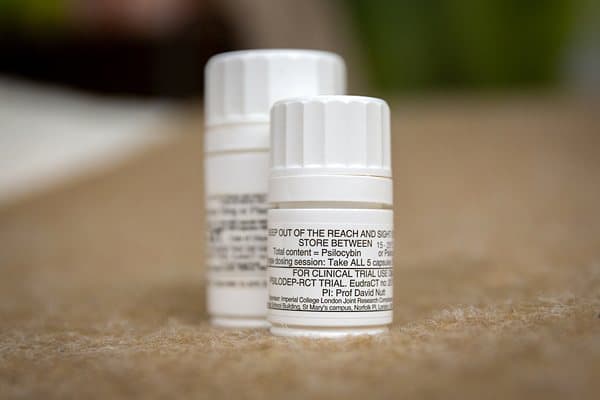
Trial medication from PSILODEP-RCT at Imperial College London — the trial described above. Psilocybin here is an investigational medicinal product: a labeled bottle, a EudraCT number, a named principal investigator.
The antidepressant problem
This is the limitation that changes who the numbers apply to, and it is almost never stated next to them. Most psilocybin trials have required participants to discontinue antidepressants before dosing. The 2023 JAMA trial required at least two weeks or five half-lives, whichever was longer.[3] The published effect sizes therefore describe unmedicated people. If you currently take an antidepressant, you are not in the population those numbers came from.
The obvious inference — come off the medication, then have the session — is the one the evidence least supports. A 2024 post-hoc analysis found psilocybin’s advantage held among participants who had never been medicated, and disappeared among those who had recently discontinued.[4] Post-hoc analyzes generate hypotheses rather than settle them, and this one should not be treated as established. But it points in exactly the opposite direction to the advice commonly given.
Two smaller studies fill in what happens if you do not discontinue. A 2022 study found that two weeks of escitalopram pretreatment reduced anxiety and bad drug effects during a psilocybin session while leaving positive mood and mystical-type experience unchanged, with no serotonin syndrome observed.[5] A 2023 open-label study followed 19 people with treatment-resistant depression who stayed on their SSRI, and responses occurred.[6] Nineteen people, open-label, no control group: that shows SSRIs do not obviously abolish a response. It cannot show that they improve one, and it cannot estimate an effect size.
Taken together, the honest position is that nobody knows what psilocybin does in medicated people, and the case for tapering in order to qualify for a program or a trial is weaker than it is usually presented. Do not taper to qualify for anything without a prescriber managing it.
How many people this is actually for
The Phase 3 program is aimed at treatment-resistant depression, not at depression in general, and the size of that group is worth stating precisely. About 2.8 million US adults meet treatment-resistant criteria — 30.9% of adults being treated with medication for major depression.[8]
That number does two things at once, which is why we lead with it rather than with an effect size. It bounds the claim: psilocybin is being developed for people for whom existing treatment has already failed twice, not as a first-line alternative to an SSRI. And it makes the modest effect matter anyway. A three- or four-point average difference across a population that size is not a small amount of relief, even though it is a small number.
What Oregon’s data does and does not tell you
Oregon runs the first state-regulated psilocybin services program in the United States, and the first outcomes study from it covers 346 clients across 24 service centers. Of those, 91.5% reported benefit at one month, and 2% described the experience as harmful at three months.[9]
Those figures are worth having, and they are not evidence of efficacy. There was no control group, so nothing in the study can separate the drug from expectation, from the attention of a facilitator, or from the fact that people generally seek help when they feel worst and tend to improve afterwards regardless. Participants were also healthier than trial populations, with only about half reporting moderate-to-severe depression at baseline. A 91.5% benefit rate in a self-selected, self-reporting, uncontrolled sample is not comparable with a 3.6-point difference in a randomized trial, and the two should never be quoted in the same breath as though they were measuring the same thing.
What the Oregon data is genuinely good for is the safety side. Real-world programs surface harms that tightly screened trials exclude by design, and a 2% harm rate at three months in an unscreened-by-trial-standards population is a more useful number than any efficacy figure in the same paper.
Common questions
Questions about psilocybin and depression
Does psilocybin work for depression?
Did psilocybin beat escitalopram for depression?
Can I take psilocybin if I am on an antidepressant?
Should I stop my antidepressant before a psilocybin session?
How many people have treatment-resistant depression?
Does Oregon's real-world data prove psilocybin works?
References
- 1.Compass Pathways. COMP005 and COMP006 Phase 3 topline results. 2025–2026.Both trials met their primary endpoint. The differences are modest: −3.6 MADRS points vs placebo (COMP005) and −3.8 for 25 mg vs 1 mg (COMP006).
- 2.Carhart-Harris R, et al. Trial of Psilocybin versus Escitalopram for Depression. N Engl J Med. 2021;384:1402–11.The primary outcome was NOT statistically significant (difference −2.0, 95% CI −5.0 to 0.9, p=0.17). The widely quoted response and remission figures are unadjusted secondary outcomes; the authors state no clinical conclusions can be drawn from them.
- 3.Raison CL, et al. Single-Dose Psilocybin Treatment for Major Depressive Disorder: A Randomized Clinical Trial. JAMA. 2023;330(9):843–53.Required antidepressant discontinuation for ≥2 weeks or 5 half-lives before dosing.
- 4.Erritzoe D, et al. Effect of recent SSRI discontinuation on psilocybin outcomes. J Psychopharmacol. 2024;38(5).Post-hoc: psilocybin's advantage over escitalopram held in never-medicated participants but disappeared among recent discontinuers. Inverts the common advice to taper quickly before a session.
- 5.Becker AM, et al. Acute Effects of Psilocybin After Escitalopram Pretreatment. Clin Pharmacol Ther. 2022;111(4):886–95.Two weeks of escitalopram reduced anxiety and bad drug effects but left positive mood and mystical-type experience unchanged. No serotonin syndrome.
- 6.Goodwin GM, et al. Psilocybin for treatment-resistant depression in patients taking a concomitant SSRI. Neuropsychopharmacology. 2023;48(10):1492–99.Open-label, n=19, no control group. Shows SSRIs do not obviously abolish response — not that they improve it.
- 7.Lewis G, et al. Maintenance or Discontinuation of Antidepressants in Primary Care (ANTLER). N Engl J Med. 2021;385:1257–67.56% relapsed within a year after discontinuation vs 39% on maintenance. The reason no website should tell you to stop your medication.
- 8.Zhdanava M, et al. Prevalence and National Burden of Treatment-Resistant Depression in the United States. J Clin Psychiatry. 2021;82(2):20m13699.About 2.8 million US adults — 30.9% of those medication-treated for major depression — meet treatment-resistant criteria.
- 9.Korthuis PT, Wilson-Poe AR, et al. Safety and Mental Health Outcomes of Oregon State-Regulated Psilocybin Services. JAMA Netw Open. 2026.The first real-world outcomes data from a legal US program: 346 clients at 24 service centers, Nov 2024–Jun 2026. Observational, not randomized, and participants were healthier than trial populations — it cannot establish efficacy, only what happens in practice.
- 10.Metapsy. Psilocybin-Assisted Therapy for Depression (Intervention vs. Control): a living meta-analytic database and online analysis tool.Serious academic infrastructure — built by researchers at the Vrije Universiteit Amsterdam, FAU Erlangen-Nürnberg and TU Munich, on a database compiled by the Sypres collaboration — but it is a tool rather than a paper. Pooled effects, heterogeneity, publication-bias and risk-of-bias output are computed only when a reader runs an analysis, and the page carries no fixed pooled estimate and no version date. We cite it as a resource and attribute no pooled figure to it.