Skip to content
Psilocybin Research

What psilocybin research actually shows

Every major trial, with the things that decide whether a result means anything — design, sample size, comparator, and whether the primary endpoint was met — reported next to the headline rather than after it.

The evidenceReviewed

The short answer

The evidence for psilocybin is real, modest, and consistently overstated — and the strongest trial in the field is in alcohol use disorder, not depression. Two Phase 3 depression trials met their primary endpoints with differences of 3.6 and 3.8 MADRS points, which is genuine and about the size of a conventional antidepressant effect. The field’s most-quoted trial did not meet its primary endpoint at all. There is no published trial data on psilocybin for PTSD, a condition it is nonetheless widely marketed for.

Trials in the ledger
7
With a control group
5 of 7
Primary endpoint met
Trials in PTSD
0

By condition

Where the evidence actually stands

Ranked by the quality of the underlying trials rather than by how much attention each one gets. These two orders are almost inverted.

Alcohol use disorder

Strongest evidence

The best-designed trial in the field is in alcohol use disorder, not depression: 95 participants, double-blind, with an active placebo rather than an inert one, showing heavy drinking days of 9.7% against 23.6% over 32 weeks.

Our read: The only trial to use an active placebo, which is the field's central methodological weakness everywhere else.
Alcohol use disorder in full

Depression

Promising, modest effects

Two Phase 3 trials of synthetic psilocybin met their primary endpoints in 2025 and 2026, with modest differences of 3.6 and 3.8 MADRS points. The most-quoted trial in the field — psilocybin versus escitalopram — did not meet its primary endpoint.

Our read: The largest evidence base, and the most misreported. Effect sizes are real, statistically significant, and modest.

Depression in full

How it works in the brain

Early and exploratory

Psilocin acts primarily at the serotonin 5-HT2A receptor, and imaging studies report changes in brain connectivity and structure that outlast the acute effects. The mechanism by which any of this would produce durable clinical benefit is not established.

Our read: Small, exploratory, frequently unreplicated studies. Mechanistic plausibility is not evidence of benefit.

How it works in the brain in full

PTSD

No published trial data

There is no published clinical trial data on psilocybin for PTSD. The US Department of Veterans Affairs states this plainly, and neither psilocybin nor MDMA appears in the VA/DoD Clinical Practice Guideline for PTSD.

Our read: Widely marketed for PTSD anyway. This is the clearest gap between what is sold and what is known.

PTSD in full

The strength rating is our editorial judgment, not a formal GRADE assessment, and we label it that way wherever it appears. The underlying trial characteristics in the table below are facts; the ranking is a reading of them.

Find your condition

What we know, and what is recruiting

Ten grouped categories across every psilocybin trial currently enrolling. Each one shows our assessment where we have published it, and says so where we have not.

What the evidence shows

Promising, modest effects

The largest evidence base, and the most misreported. Effect sizes are real, statistically significant, and modest.

Depression in full

The ledger

Every trial, with what qualifies it

Sample size, control group, blinding and primary endpoint sit beside the result rather than in a paragraph underneath it. Read the two together.

Clinical trials of psilocybin, with design, sample size, comparator and whether the primary endpoint was met
TrialDesignParticipantsPrimary endpointResult and limitation
COMP005 and COMP006 (Compass Phase 3)2026 · Treatment-resistant depressionSource ↗

Two randomized Phase 3 trials of synthetic psilocybin (COMP360)

ControlledDouble-blind

Compared against: Placebo (COMP005); 1 mg active comparator (COMP006)

Not published in fullMet

Both met their primary endpoint. The differences were −3.6 MADRS points versus placebo at week six, and −3.8 points for 25 mg against 1 mg.

Read it with this: Topline results released by the sponsor, not yet published in full. The effect sizes are modest and in the same broad range as conventional antidepressants in acute trials.

Psilocybin for alcohol use disorder2022 · Alcohol use disorderSource ↗

Randomized, double-blind trial with 12 psychotherapy sessions in both arms

ControlledDouble-blind

Compared against: Active placebo (diphenhydramine)

95Met

Heavy drinking days 9.7% versus 23.6% over 32 weeks — a mean difference of 13.9 percentage points (95% CI 3.0–24.7, p=0.01, Hedges g=0.52). Abstinence 47.9% versus 24.4%.

Read it with this: The blind was still not fully maintained, and the psilocybin effect cannot be separated from the twelve psychotherapy sessions both arms received.

Single-dose psilocybin for major depressive disorder2023 · Major depressionSource ↗

Randomized trial of a single 25 mg dose

ControlledDouble-blind

Compared against: Niacin

104Met

A significant reduction in depression scores against niacin over six weeks.

Read it with this: Participants had to discontinue antidepressants for at least two weeks or five half-lives before dosing, so the result does not describe people currently taking medication.

Psilocybin versus escitalopram2021 · Major depressionSource ↗

Randomized head-to-head against a standard antidepressant

ControlledDouble-blind

Compared against: Escitalopram

59Not met

The primary outcome was not statistically significant: a difference of −2.0 points (95% CI −5.0 to 0.9, p=0.17).

Read it with this: The famous response and remission figures from this trial are unadjusted secondary outcomes. The authors state explicitly that no clinical conclusions can be drawn from them.

Psilocybin alongside a continuing SSRI2023 · Treatment-resistant depressionSource ↗

Open-label study in people who stayed on their SSRI

No control groupOpen-label

Compared against: None

19No primary endpoint

Response was observed in participants who did not discontinue their antidepressant.

Read it with this: Nineteen people, open-label, no control group. It shows SSRIs do not obviously abolish a response. It does not show they improve one, and it cannot estimate effect size.

Oregon state-regulated psilocybin services2026 · Major depressionSource ↗

Observational study of a real-world legal program

No control groupNot blinded

Compared against: None

346Not applicable

91.5% of clients reported benefit at one month; 2% described the experience as harmful at three months.

Read it with this: No control group, so it cannot attribute benefit to psilocybin. Participants were healthier than typical trial populations, with only about half reporting moderate-to-severe depression at baseline.

Brain changes after first psilocybin use2026 · Healthy volunteersSource ↗

Placebo-controlled imaging study, fixed order

ControlledSingle-blind

Compared against: Placebo

28No primary endpoint

Measurable changes in brain structure persisting beyond the acute drug effect.

Read it with this: Twenty-eight healthy volunteers, exploratory, not pre-registered, and fixed-order rather than randomized. The authors explicitly call for replication.

The ledger lists trials individually rather than pooling them. For depression, the Metapsy project maintains a living meta-analytic database of these randomized trials that will pool them on request, with heterogeneity, publication-bias and risk-of-bias output alongside.[5] Its figures are computed when a reader runs an analysis rather than stated on the page, so we quote none of them here — but a pooled estimate from a database of that kind outranks any single trial in the table above, and it is the right place to check anything we say against.

Uncertainty

Which results hold up, and which might be nothing

A trial reports one number, but the real finding is a range. Where that range sits tells you whether a result survives its own uncertainty. Only 2 of the 7 trials above publish one; the rest are listed below with the reason.

Psilocybin for alcohol use disorder2022 · Alcohol use disorder · n=95
−13.9 (95% CI −24.7 to −3.0)

This is a real difference. The whole range of possible answers sits on one side of zero, so the effect holds up even at the pessimistic end. Scale: percentage points of heavy drinking days. Below zero favors fewer heavy drinking days on psilocybin. p=0.01. Hedges g=0.52.

Psilocybin versus escitalopram2021 · Major depression · n=59
−2.0 (95% CI −5.0 to 0.9)

This might be nothing. The range of possible answers still includes zero, so these data are also compatible with the treatment doing nothing at all. Scale: QIDS-SR-16 points versus escitalopram. Below zero favors lower depression score on psilocybin. p=0.17.

Each trial is drawn against its own scale, because percentage points of heavy drinking days and points on a depression questionnaire are not the same quantity. Only the position of zero is shared, and it is the only comparison being invited.

Why the other 5 are absent

COMP005 and COMP006 (Compass Phase 3)
Point estimates released as sponsor topline (−3.6 and −3.8 MADRS points). No confidence interval published yet.
Single-dose psilocybin for major depressive disorder
Reported as a significant reduction against niacin without a published interval here.
Psilocybin alongside a continuing SSRI
A secondary analysis of response, with no primary endpoint to size.
Oregon state-regulated psilocybin services
Program outcome data with no control group, so no difference to estimate.
Brain changes after first psilocybin use
An imaging study. The outcome is a structural change, not a symptom difference.

That distribution is the honest state of this literature. Filling the gaps with figures converted between scales, or read off a published graph, would manufacture the precision this page exists to question.

The two problems that run through all of it

Almost every criticism worth making of this literature reduces to one of two things, and neither is a reason to dismiss the research. They are reasons to size the claims correctly.

Blinding does not hold. Participants can tell whether they received a psychedelic — the effects are unmistakable — and so can the people rating them. That inflates apparent benefit through expectation in ways trials rarely quantify. Most trials compare against an inert placebo, which makes the problem worse rather than better. The alcohol use disorder trial is the field’s honorable exception: it used diphenhydramine, an active placebo that produces noticeable effects of its own, and the authors still reported that the blind was not fully maintained.[1]

The results describe unmedicated people. Most trials required participants to be off antidepressants before dosing.[2] Since roughly one in eight American adults takes one, the published effect sizes do not describe a large share of the people reading about them. This is not a footnote. It is a limit on who the numbers apply to.

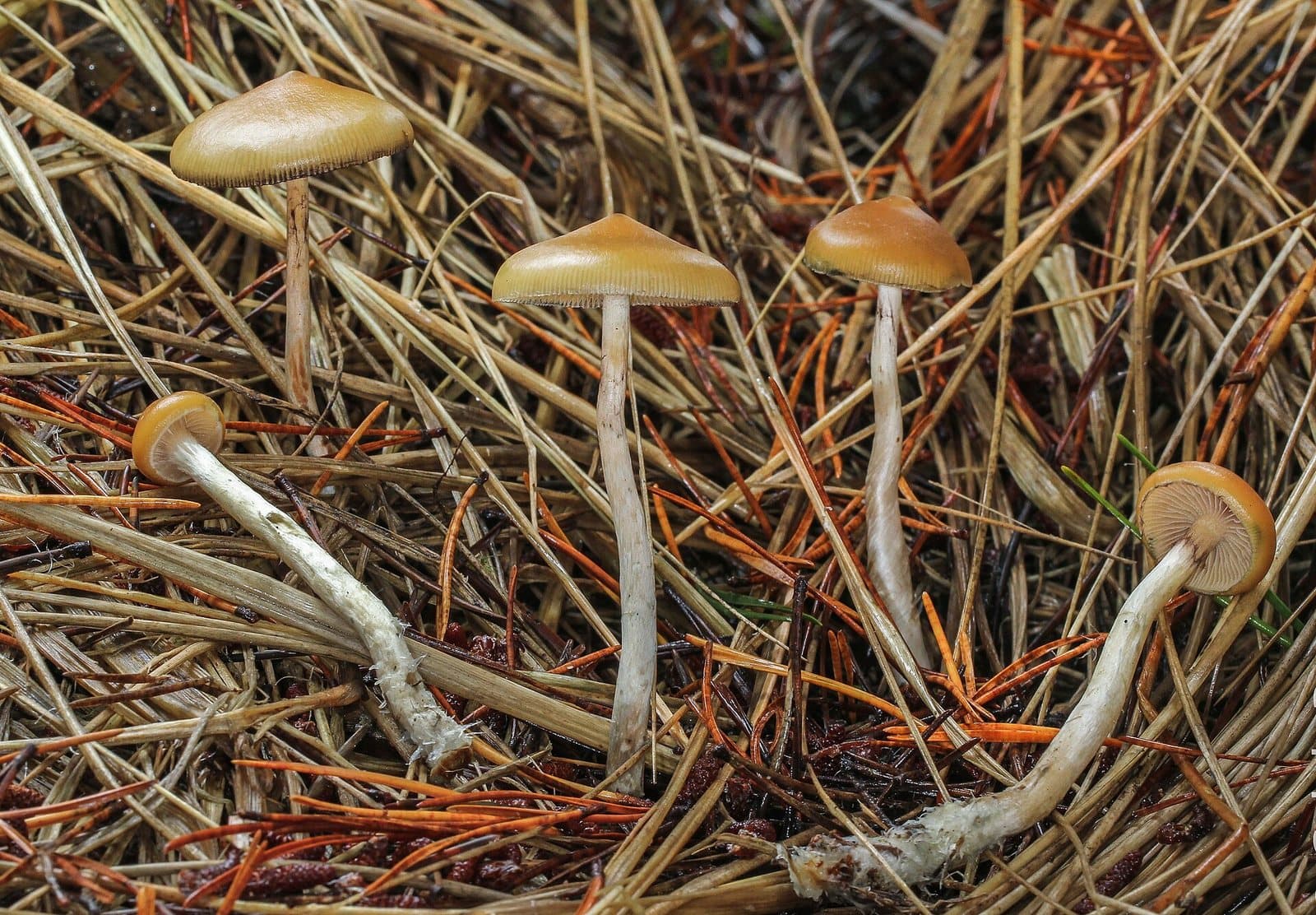
Five slender caramel-capped mushrooms with pale wavy stems growing among dried beach grass and orange conifer needles.

Psilocybe azurescens on the Oregon coast. Everything on this page was measured in a synthesised, precisely weighed compound given under supervision — not in this. The mushroom is where the molecule was found, not what the trials studied.

Caleb Brown · CC BY-SA 3.0

What would change our reading

Stating this in advance is the only way a judgment like ours can be held to account later. We would revise upward on: a large trial using an active placebo that replicates the depression results; published data in PTSD of any quality; or durable outcomes beyond twelve months in a controlled sample. We would revise downward on: failure to replicate the Phase 3 results, or a serious adverse-event signal emerging from Oregon or Colorado at scale.

Common questions

Questions about the evidence

Does psilocybin work for depression?
Answered in full on the depression evidence page, which is the page that keeps it current.
What is the strongest evidence for psilocybin?
Alcohol use disorder, not depression. The 2022 trial by Bogenschutz and colleagues randomized 95 people, was double-blind, and used an active placebo (diphenhydramine) rather than an inert one — which addresses the field's central methodological weakness. Heavy drinking days were 9.7% versus 23.6% over 32 weeks. Even there, the authors note the blind was not fully maintained and the psilocybin effect cannot be separated from the twelve psychotherapy sessions both groups received.
Is there evidence psilocybin helps PTSD?
No. There is no published clinical trial data on psilocybin for PTSD. The US Department of Veterans Affairs states this directly, and neither psilocybin nor MDMA appears in the VA/DoD Clinical Practice Guideline for PTSD. Psilocybin is nonetheless widely marketed for PTSD, which makes this the clearest gap between what is sold and what is known.
Why is blinding a problem in psychedelic research?
Participants and investigators can almost always tell who received a psychedelic, because the effects are unmistakable. That breaks the blind and inflates apparent benefit through expectation, in ways trials rarely measure. Most psilocybin trials use an inert placebo, which makes the problem worse. The alcohol use disorder trial is the notable exception, using an active placebo that produces noticeable effects of its own.
Do psilocybin trials include people taking antidepressants?
Mostly not. Most trials have required participants to discontinue antidepressants before dosing — the 2023 JAMA trial required at least two weeks or five half-lives, whichever was longer. That means the published effect sizes describe unmedicated people. If you currently take an antidepressant, you are not the population those numbers describe, and a 2024 analysis found psilocybin's advantage disappeared among people who had recently discontinued.

References

  1. 1.Bogenschutz MP, Ross S, Bhatt S, et al. Percentage of Heavy Drinking Days Following Psilocybin-Assisted Psychotherapy vs Placebo in Adult Patients With Alcohol Use Disorder: A Randomized Clinical Trial. JAMA Psychiatry. 2022;79(10):953–62.The best-designed trial in the field: n=95, double-blind, with an ACTIVE placebo (diphenhydramine) rather than an inert one. Heavy drinking days 9.7% vs 23.6% over 32 weeks (mean difference 13.9%, 95% CI 3.0–24.7, p=0.01, Hedges g=0.52). Abstinence 47.9% vs 24.4%. The authors note the blind was still not fully maintained, and psilocybin's effect cannot be separated from the 12 accompanying psychotherapy sessions.
  2. 2.Raison CL, et al. Single-Dose Psilocybin Treatment for Major Depressive Disorder: A Randomized Clinical Trial. JAMA. 2023;330(9):843–53.Required antidepressant discontinuation for ≥2 weeks or 5 half-lives before dosing.
  3. 3.Carhart-Harris R, et al. Trial of Psilocybin versus Escitalopram for Depression. N Engl J Med. 2021;384:1402–11.The primary outcome was NOT statistically significant (difference −2.0, 95% CI −5.0 to 0.9, p=0.17). The widely quoted response and remission figures are unadjusted secondary outcomes; the authors state no clinical conclusions can be drawn from them.
  4. 4.Lewis G, et al. Maintenance or Discontinuation of Antidepressants in Primary Care (ANTLER). N Engl J Med. 2021;385:1257–67.56% relapsed within a year after discontinuation vs 39% on maintenance. The reason no website should tell you to stop your medication.
  5. 5.Metapsy. Psilocybin-Assisted Therapy for Depression (Intervention vs. Control): a living meta-analytic database and online analysis tool.Serious academic infrastructure — built by researchers at the Vrije Universiteit Amsterdam, FAU Erlangen-Nürnberg and TU Munich, on a database compiled by the Sypres collaboration — but it is a tool rather than a paper. Pooled effects, heterogeneity, publication-bias and risk-of-bias output are computed only when a reader runs an analysis, and the page carries no fixed pooled estimate and no version date. We cite it as a resource and attribute no pooled figure to it.