Commonly misreported
The claims that circulate and are wrong — about the law, the evidence, safety and cost — with what is actually true and the source that settles it.
The short answer
Most bad information about psilocybin is not invented. It is a real finding with its qualifier removed. A trial that missed its primary endpoint becomes a trial that beat antidepressants. A city council resolution becomes decriminalization. An observational survey becomes an efficacy result. Each entry below is a claim we have seen circulating, what is actually true, and the primary source that settles it.
2 of these 19 correct claims that understate psilocybin rather than overstate it, and they are labeled. A page that only ever deflates enthusiasm is not fact-checking.
- Claims corrected
- 19
- About the law
- 7
- That favor psilocybin
- 17
- That understate it
- 2
The ledger
Claims, and what is actually true
Filter by what you are checking. Every entry links to the primary source rather than to another tracker.
19 corrections.
- Legal status
“Psilocybin has been decriminalized in dozens of US cities.”
Those cities passed deprioritization, which changes no law at all.
Almost every American city described as having decriminalized psychedelics has in fact passed a resolution instructing police to treat enforcement as their lowest priority. The criminal code is untouched. It binds no prosecutor, offers no legal defense, does not affect federal jurisdiction, and can be reversed at the next council meeting. If you are relying on a city resolution as legal cover, you do not have legal cover.
- Legal status
“Nevada decriminalized psilocybin.”
It did not. The bill was amended into a working group before it passed.
SB 242 was introduced with decriminalization language — the 'four ounces, adults 18 and over' text that still appears in several national trackers — and was amended before passage to create a study working group and nothing more. The enacted law changed no penalty. Trackers repeating the introduced version are quoting a bill that never became law.
- Legal status
“Connecticut decriminalized psilocybin.”
Decriminalization bills passed the House twice and died in the Senate both times.
Connecticut's real reform is a therapy pilot program, which is a genuinely different thing from decriminalization and is worth reporting accurately on its own terms. Possession remains a criminal offense under state law.
- Legal status
“Rhode Island decriminalized psilocybin.”
The 2023 bill passed one chamber; the 2026 successor was withdrawn.
Neither became law. Rhode Island appears on several national decriminalization lists on the strength of a bill that did not pass.
- Legal status
“My state legalized psilocybin — it passed a law.”
Trigger laws create zero access until two federal events happen.
Several states have statutes that change psilocybin's status automatically once the FDA approves a psilocybin medicine and the DEA reschedules it. Neither has happened. Until both do, those laws authorize nothing whatsoever. A headline reading 'Virginia legalizes psilocybin' describes a statute that currently does nothing at all.
- Legal status
“The 2026 executive order legalized psychedelics.”
An executive order cannot approve a drug or reschedule a controlled substance.
Executive Order 14401 directs the FDA, HHS, DEA and VA to accelerate psychedelic research and access, and instructs the Attorney General to review Schedule I substances for possible rescheduling after successful Phase 3 trials. Directing a review is not performing one. Psilocybin's legal status is unchanged.
- Legal status
“The FDA fast-tracked psilocybin, so approval is imminent.”
A priority voucher shortens the queue. It does not lower the bar.
Three sponsors hold Commissioner's National Priority Vouchers, which compress administrative review from roughly ten to twelve months down to one or two once an application is under active review. That is genuinely significant — it could save the better part of a year. But it operates on the calendar, not the evidentiary standard. The sponsor still has to demonstrate safety and efficacy, an application still has to be filed, and rescheduling would follow approval rather than accompany it.
- Efficacy
“A trial found psilocybin outperformed antidepressants for depression.”
The primary outcome was not statistically significant. p=0.17.
In the 2021 trial comparing psilocybin with escitalopram, the difference on the primary outcome was −2.0 points, 95% CI −5.0 to 0.9, p=0.17. The response and remission figures that circulate from this trial are unadjusted secondary outcomes, and the authors state explicitly that no clinical conclusions can be drawn from them. This is the single most misreported result in the field, and it is misreported in psilocybin's favor.
- Efficacy
“The Phase 3 results show psilocybin is transformative for depression.”
Both trials met their endpoint. The differences were 3.6 and 3.8 MADRS points.
Those results are real and statistically significant, and they matter. They are also modest, and in the same broad range as conventional antidepressants in acute trials. We are not going to criticize antidepressants for a moderate average effect and then wave psilocybin through on the same numbers.
- Efficacy
“91.5% of people in Oregon's program benefited from psilocybin.”
That figure is real, and it is not an efficacy result.
The Oregon outcomes study is observational: 346 clients across 24 service centers, with no control group. It cannot tell you how much of the reported benefit psilocybin caused. The authors also note participants were healthier than typical trial populations, with only about half reporting moderate-to-severe depression at baseline. It describes what happens in practice. Anyone quoting the 91.5% without that sentence attached is selling something.
- Efficacy
“Microdosing improves mood, focus and creativity.”
In the largest placebo-controlled test, it did not beat placebo.
191 people completed a randomized, placebo-controlled, self-blinded study. Both groups improved from baseline, and there were no significant differences between them. Scores tracked what participants believed they had taken rather than what they actually took. The benefit people report is real to them; the evidence says it comes from expectation rather than pharmacology.
- Efficacy
“Psilocybin treats PTSD.”
There is no published clinical trial data on psilocybin for PTSD.
The US Department of Veterans Affairs states this plainly, and neither psilocybin nor MDMA appears in the VA/DoD Clinical Practice Guideline for PTSD. Trials are now recruiting, which is how this will eventually be answered — but a recruiting trial is a question, not a result. Psilocybin is marketed for PTSD regardless, and veterans are targeted specifically.
- EfficacyCorrects a claim against psilocybin
“Psychedelic research is all hype with no real evidence behind it.”
The alcohol use disorder trial is genuinely well designed, and it worked.
A correction that cuts the other way. The 2022 trial randomized 95 people, was double-blind, and used an active placebo — diphenhydramine — rather than an inert one, which addresses the field's central methodological weakness. Heavy drinking days were 9.7% against 23.6% over 32 weeks. Dismissing the whole field is as inaccurate as overselling it.
- Safety
“Just come off your antidepressant first and you'll get a better result.”
The evidence points the other way, and the risk is real.
A 2024 analysis found psilocybin's advantage over escitalopram held among people who had never been medicated but disappeared among recent discontinuers, whose depression scores had risen during the washout. Separately, 56% of people relapsed within a year of stopping an antidepressant, against 39% who continued. A rushed taper may be the worst preparation rather than the best. Never do it without a prescriber managing it.
- Safety
“Psilocybin isn't addictive, so it's safe.”
Both halves need qualifying. Low addiction potential is not low risk.
NIDA states that psilocybin use does not typically lead to addiction, and there are no psilocybin-specific substance use disorder criteria in DSM-5. That is accurate and it is not the same as safe. Psilocybin raises blood pressure and heart rate, which can be dangerous for people with heart conditions. A personal or family history of psychosis or bipolar I disorder is an exclusion in essentially every trial. Lithium is associated with seizures. The risks are concentrated in identifiable groups rather than spread thinly across everyone.
- Safety
“These are rigorous double-blind trials, so the results are solid.”
Participants can almost always tell what they were given.
The effects of a psychedelic are unmistakable, so both participants and the people rating them usually know the assignment. That breaks the blind and inflates apparent benefit through expectation, in ways trials rarely quantify. Most psilocybin trials compare against an inert placebo, which makes it worse. The VA names this limitation explicitly in its own assessment.
- Safety
“The trial results tell me what to expect.”
Only if you are not taking psychiatric medication.
Most psilocybin trials required participants to be off antidepressants before dosing — the 2023 JAMA trial required at least two weeks or five half-lives, whichever was longer. Roughly one in eight American adults takes an antidepressant. If you are one of them, the published effect sizes do not describe you.
- Cost and access
“Insurance will cover psilocybin therapy.”
No US insurer, Medicare or Medicaid program covers it. None.
Coverage follows FDA approval, and psilocybin has none. A supervised session at a licensed center in Oregon or Colorado costs roughly $1,000 to $3,500, paid entirely out of pocket, and HSA and FSA funds generally cannot be used either. This is the main reason esketamine and TMS cost a patient less despite being no cheaper to deliver: they are approved, so they can be billed.
- Cost and accessCorrects a claim against psilocybin
“There is no legal way to access psilocybin unless you live in Oregon or Colorado.”
A clinical trial is lawful in every state, and free.
Another correction that cuts the other way. Trials cost nothing, frequently compensate participants, and the sponsor covers the drug and the sessions. Dozens are open with US sites. Eligibility is the real barrier rather than geography or money — and roughly a third require you to stop psychiatric medication, which is the criterion that excludes most people.
How a real finding turns into a false claim
It is worth understanding the mechanism, because once you can see it you will catch these yourself without needing us.
A study reports a primary outcome and a set of secondary ones. The primary outcome is the question the trial was designed and powered to answer; the secondaries are exploratory, and statisticians adjust for the fact that testing many things makes a striking result more likely by chance. When a primary outcome disappoints and a secondary one looks dramatic, the dramatic number is the one that travels. By the third retelling the caveat is gone, and by the tenth the number is being quoted back at the authors who published the caveat.
The same thing happens in law. A bill is introduced with sweeping language, gets amended down to a study group before passage, and the introduced version is what ends up in the tracker. Nobody lied. Someone read the first draft and not the last one.
When we are the ones who get it wrong
This page is the most demanding thing on the site to publish, because every entry is an invitation to check our work. That is the point. If we have a correction wrong, or you have seen a claim we have not covered, write to [email protected]. We fix errors on the page, dated, and say what changed — we do not quietly edit them away.
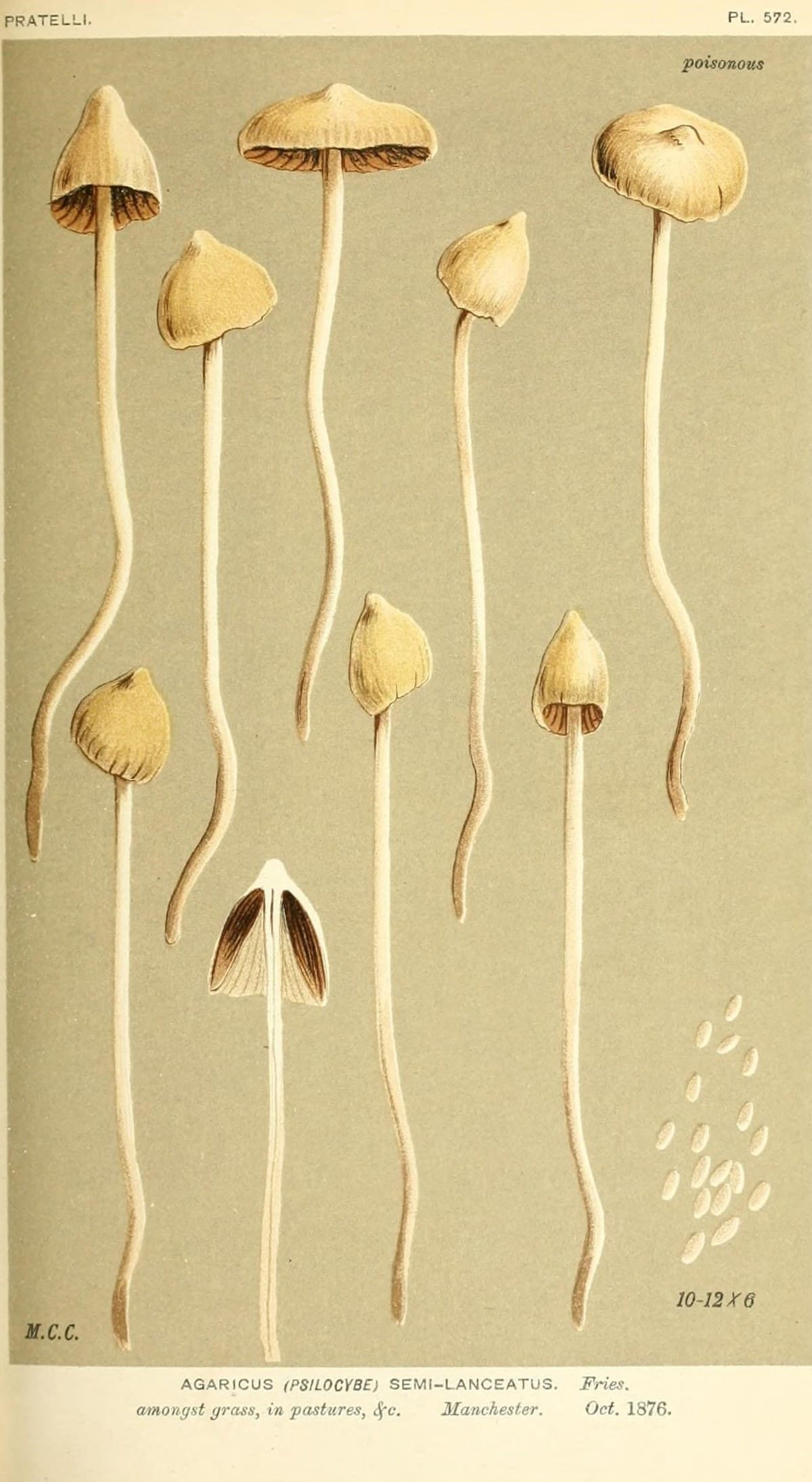
Mordecai Cubitt Cooke drew this plate from liberty caps collected in a Manchester pasture in October 1876, down to the spore print at lower right. Note the word at the top of the plate: poisonous. That was the settled scientific view of this mushroom eighty years before anyone isolated psilocybin from it.
Common questions