The psilocybin development pipeline
How far away is prescription access?
Of the 133 psilocybin trials currently open on ClinicalTrials.gov, only 8 are at Phase 3 or Phase 2/3 — the only stage whose results can support an FDA approval. Everything else is earlier-stage work asking whether there is something worth confirming.
One program is further along than that count suggests. Compass Pathways reported positive results from two late-stage trials of COMP360 and, in February 2026, said it expected to submit an approval application between October and December 2026. That submission has not happened yet, and an FDA review takes most of a year after filing even when it goes well.
Source: Compass Pathways reports positive late-stage COMP360 results; plans FDA submission. BioPharma Dive, 17 February 2026. Trade press reporting a company statement of intent, not a regulatory filing. As of this page's review date no application had been submitted, and a planned filing window is not an approval date.
Pipeline pages are usually published by companies, and they show that company’s own programs. This one is the whole field, because the question underneath “what is in the pipeline” is almost always “when can I actually get this” — and that is answered by the shape of the distribution rather than by any single program.
The shape is the finding. A field concentrated at Phase 1 and Phase 2 is a field where the central question is still open. That reads as discouraging if you were told approval was imminent, and as encouraging if you were told the science was nonsense. Both of those framings are wrong, and the table below is why.
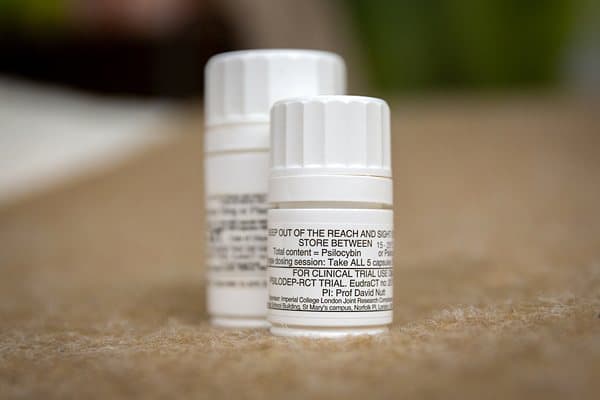
Trial medication from PSILODEP-RCT at Imperial College London: psilocybin as an investigational medicinal product, in a labeled bottle with a EudraCT number and a named principal investigator on it. This is what the drug looks like inside the research this site reports on.
Open trials by phase
Every trial recruiting, not yet recruiting, or enrolling by invitation.
Early Phase 1
13trials
First-in-human and exploratory work, usually a handful of participants.
Establishes that a dose can be given and measured. Says nothing about whether it helps anyone.
Phase 1
34trials
Safety, tolerability and dosing, often in healthy volunteers.
Designed to find harms and set a dose. Not designed to detect benefit, and usually has no control group.
Phase 1/2
9trials
Combined safety and early efficacy, run as one protocol.
Efficient, and correspondingly harder to interpret than either phase run alone.
Phase 2
67trials
Does it work, in a few dozen to a few hundred people with the condition.
Where most of the encouraging psilocybin headlines come from. Phase 2 results routinely fail to replicate at Phase 3, across all of medicine.
Phase 2/3
2trials
Seamless designs that roll efficacy into confirmation.
Counted separately because they are neither one thing nor the other.
Redefine Study: A Study Evaluating the Efficacy, Safety, and Tolerability of COMP360 in Participants With Post-traumatic Stress Disorder
COMPASS Pathways · aiming to enroll 300 · PTSD - Post Traumatic Stress Disorder, PTSD
NCT07570654Psilocybin Therapy in Advanced Cancer
NYU Langone Health · aiming to enroll 200 · Advanced Cancer
NCT05398484
Phase 3
6trials
Confirmation in a large, controlled population. The phase an approval is built on.
The only phase whose results can support an FDA new drug application. This is the number that determines how far away legal prescription access actually is.
Psilocybin Intervention for Veterans Overcoming Treatment-Resistant Depression
VA Office of Research and Development · aiming to enroll 240 · Major Depression
NCT07226232The Effects of Psilocybin on Self-Focus and Self-Related Processing in Major Depressive Disorder
Sharmin Ghaznavi · aiming to enroll 20 · Major Depressive Disorder
NCT06247839Efficacy in Relapse Prevention: Psilocybin in Alcohol Use Disorder With Depressive Symptoms
Centre Hospitalier Universitaire de Nīmes · aiming to enroll 172 · Alcohol Use Disorder, Depressive Sympotoms
NCT07638553Psilocybin-Assisted Therapy for Treatment-Resistant Depression in Bipolar II Disorder
Lakshmi N Yatham · aiming to enroll 90 · Bipolar II Depression
NCT06943573Psilocybin Microdose for Psychological and Existential Distress in Palliative Care (PSYCHED-PAL-RCT)
Bruyère Health Research Institute. · aiming to enroll 120 · Psychological Distress
NCT07063862Effect of Psilocybin and Structured Integrated Reframing Therapy on Gut-Brain Axis Biomarkers and Depression in Major Depressive Disorder
Khyber Medical University Peshawar · aiming to enroll 60 · Major Depressive Disorder, Post-Traumatic Stress Disorder (PTSD)
NCT07703722
Phase not stated
2trials
Observational studies and trials the registry does not phase.
Included for completeness rather than omitted, so the totals reconcile.
Phase 3 and Phase 2/3 trials are listed individually because there are few enough to name, and because they are the ones that determine the timeline. The rest are searchable in the trial finder. Registry data fetched August 31, 2026.
Who is running this work
Sponsors with more than one open trial. Universities and academic medical centers dominate, which is worth knowing when reading results: academic trials are typically smaller and more thinly funded than an industry Phase 3 program, and they are not built to support a regulatory filing.
- Johns Hopkins University
- 13
- Yale University
- 8
- NYU Langone Health
- 6
- University of Calgary
- 5
- University of Wisconsin, Madison
- 4
- Centre for Addiction and Mental Health
- 4
- M.D. Anderson Cancer Center
- 3
- Francisco A Moreno
- 2
- University of California, Los Angeles
- 2
- Charles Raison
- 2
Values are counts of trials, largest 13.
Where the work is going
Open trials by condition. This is a measure of research activity, not of evidence — a condition can attract a great deal of work and still have nothing published. Our evidence hub rates what has actually reported.
- Depression
- 43
- Other
- 27
- Substance use
- 22
- Healthy volunteers
- 15
- PTSD
- 14
- Pain
- 13
- Anxiety
- 9
- Cancer and end of life
- 7
- Neurological
- 6
- Eating disorders
- 2
Values are counts of trials, largest 43.
Questions people ask about the timeline
- When will psilocybin be available as a prescription medicine?
- The nearest concrete milestone is Compass Pathways, which reported positive results from two late-stage COMP360 trials and said in February 2026 that it expected to file an approval application between October and December 2026. That filing has not happened yet. FDA review of a new drug application typically takes most of a year after submission, so even on that timeline and with a favorable outcome, a prescription psilocybin medicine would not reach patients before late 2027. Behind it, of 133 open psilocybin trials only 8 are at Phase 3 or Phase 2/3 — the only stage whose results can support an application at all. Anyone naming a firm date is guessing.
- Why are most psilocybin trials Phase 1 and Phase 2?
- Because that is the shape of an early field. Phase 1 establishes safety and dose; Phase 2 asks whether there is a signal worth confirming. Phase 3 is expensive, slow, and only worth running once Phase 2 has produced something convincing. A field concentrated in early phases is a field where the question is still open — which is the accurate way to read it, in either direction.
- Does a Phase 2 result mean psilocybin works?
- It means there was a signal in a small controlled population. Across medicine as a whole, a substantial share of Phase 2 successes fail to replicate at Phase 3, which is the reason Phase 3 exists. Psilocybin's most-quoted trials are Phase 2, and the two Phase 3 trials that have reported met their primary endpoints with modest effect sizes.
- Who is running psilocybin research?
- Mostly universities and academic medical centers rather than pharmaceutical companies. The most active sponsors by number of open trials are Johns Hopkins University, Yale University, NYU Langone Health. That matters for interpretation: academic trials are typically smaller and less well funded than industry Phase 3 programs, and they are not designed to support a regulatory filing.